Faisal HouraniFree AI test
Learn · Guide 6

How to sell digital products.

What worked for me: a small first product, one bigger offer right after the sale, and a box for the product on the pages people already read. 100+ strangers bought my digital products, and 1 in 5 bought more right after.

By Faisal Hourani7 steps2 partsAbout 6 minutesTools: Your store's checkout, an email tool, and ChatGPT, Claude or Gemini
The numbers · my digital products, all time
100+Strangers bought a first product
$5 to $22What every first product cost
1 in 5Bought more right after
41More sales right after checkout

Every sale from the payment records, May to September 2026: counts and prices only. Most stores get about 5 to 7 extra orders per 100 from an offer after checkout (ReConvert, 16.9 million offers). Pulled October 2026.

Part 1

The first sale

My products are small digital packs for people starting a YouTube channel. AI made them. Here's what got strangers to buy the first one.

STEP 1

A small first product

A stranger doesn’t know you yet. A small price is an easy first yes, and the first yes makes the next one easier. Researchers at Stanford called it the foot in the door, back in 1966. A small product can be part of what you already sell: one template from a bundle, a sample size, the first chapter.

Try this, if it fits: could a small version of your best seller come first?
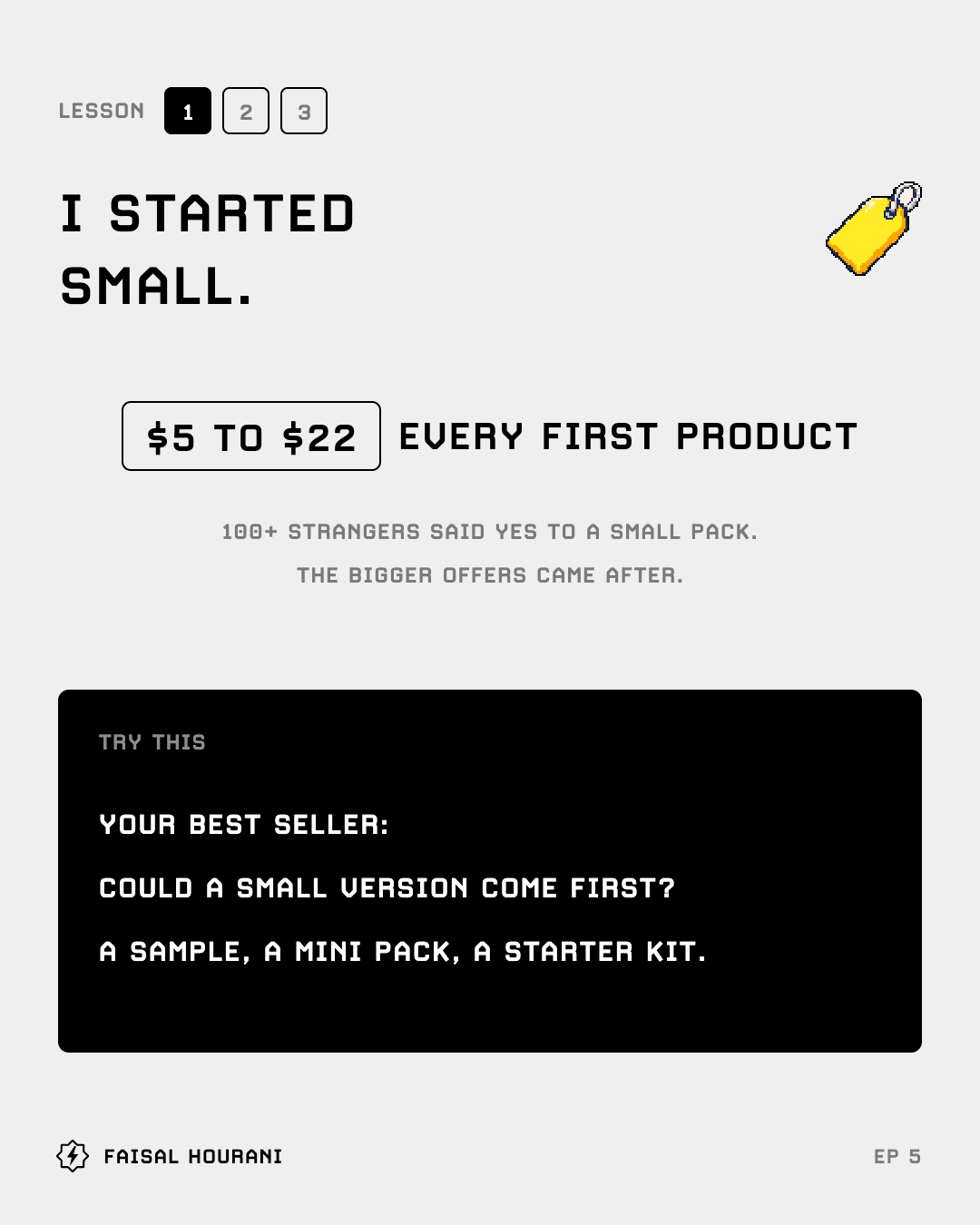
WHAT I DIDEvery first product my buyers picked cost $5 to $22. 100+ strangers said yes to a small pack. The bigger offers came after.
COPY THISLook at my store and list my 3 best sellers. For each, suggest a small first version under $25: a sample, a mini pack or a starter kit.
Lesson 1 from episode 5: I started small, every first product cost $5 to $22
STEP 2

Two prices to try

You don’t have to guess the perfect price. Pick two, both under $25, and count how many visitors buy at each. Wait until each price has enough sales that one good week can’t fool you.

Try this, if it fits: which two prices would you be happy with?

WHAT I DIDMy first products sold at five prices: $5, $9, $12, $19 and $22. Every price found buyers, and $5 found the most.
$5 or $9
Sales per 100 visitors
Enough sales at each
STEP 3

A box on the pages people read

People who find you on Google or ChatGPT land on an article, not your home page. If the article explains a problem, a small box near the top can offer the product that solves it. It reads as help, not an ad, because it’s about what they came to read (see how to rank in ChatGPT).

Try this, if it fits: your most-read page, which product does it explain?
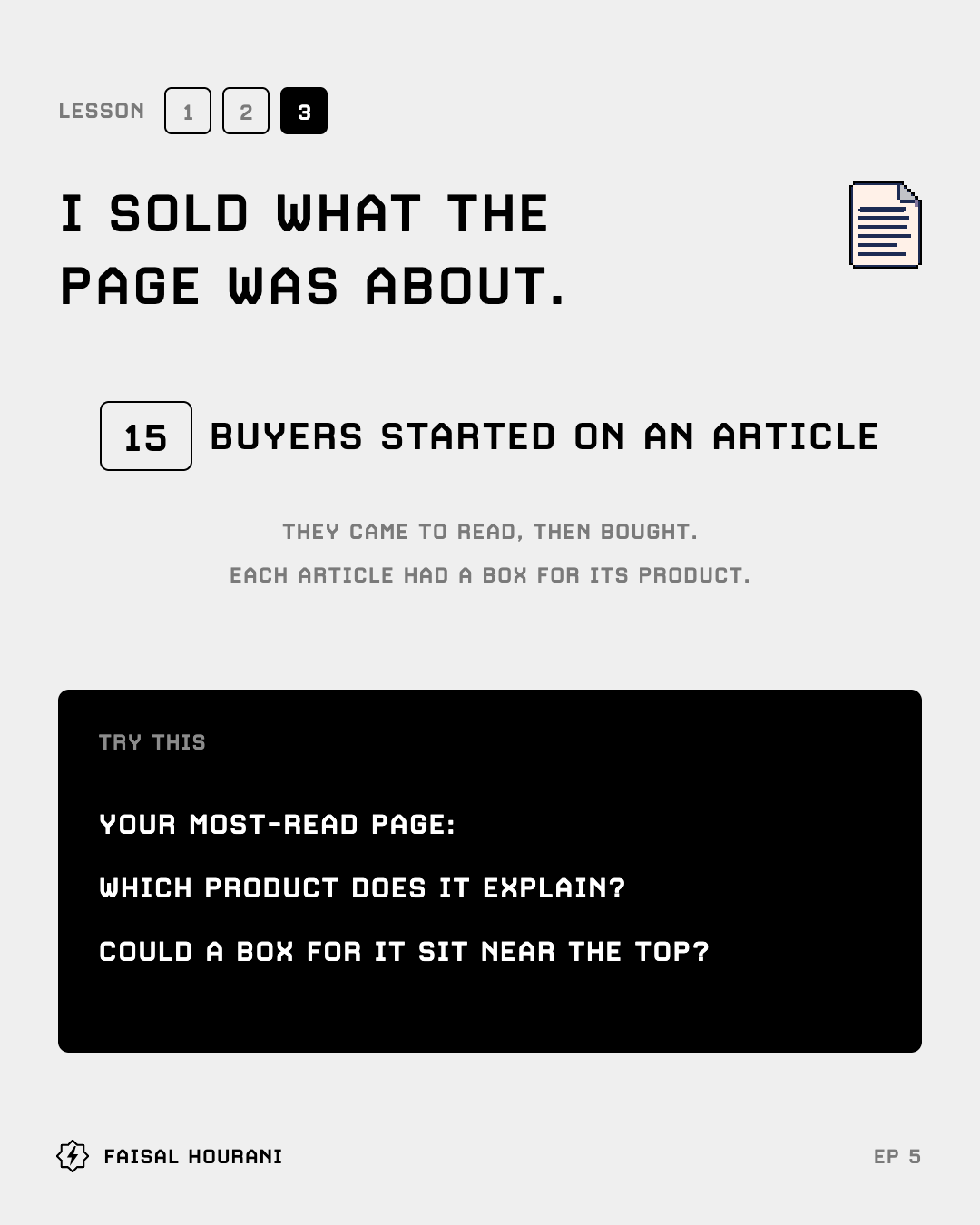
WHAT I DID15 of my buyers started on an article. Each article had a box for the product it talks about.
COPY THISSearch site:mystore.com and list the 3 pages that answer a question my buyers search for. For each, name the product it explains.
Lesson 3 from episode 5: I sold what the page was about, 15 buyers started on an article
STEP 4

One visit can be enough

Most of my buyers didn’t come back later to decide. They decided on the first visit. So the page they land on has to make buying easy right then: one clear button near the top, the price on show, no sign-up first.

Try this, if it fits: could someone buy from you on their very first visit?

WHAT I DID7 in 10 of my buyers paid within an hour of their first visit: 58 of the 82 I could time. 70 bought the same day.
7 in 10 within an hour
One clear button near the top
No sign-up first
STEP 5

A buy button that stays in reach

On a phone, people scroll and read, and the button at the top is soon gone. A small bar at the bottom of the screen keeps it in reach the whole time. Many shop themes have it as a setting, often called a sticky add-to-cart.

Try this, if it fits: on your phone, scroll your longest product page. Is a buy button still in reach?

WHAT I DID1 in 6 of my buyers tapped a buy button that stays at the bottom of the phone screen: 19 of the 112 buyers whose button I could track.
1 in 6 tapped it
Stays at the bottom
While they scroll and read
Part 2

The next sale

The first product opens the door. The second offer and the emails come after.

STEP 6

One more offer, right after they buy

The moment after a purchase is when a buyer trusts you most. Mine showed the bigger thing they’d want next, and a smaller offer if they said no. Most stores get about 5 to 7 extra orders per 100 from an offer after checkout. One in five is about three times that.

Try this, if it fits: what would your buyers want next? Could that be an offer on your thank-you page?
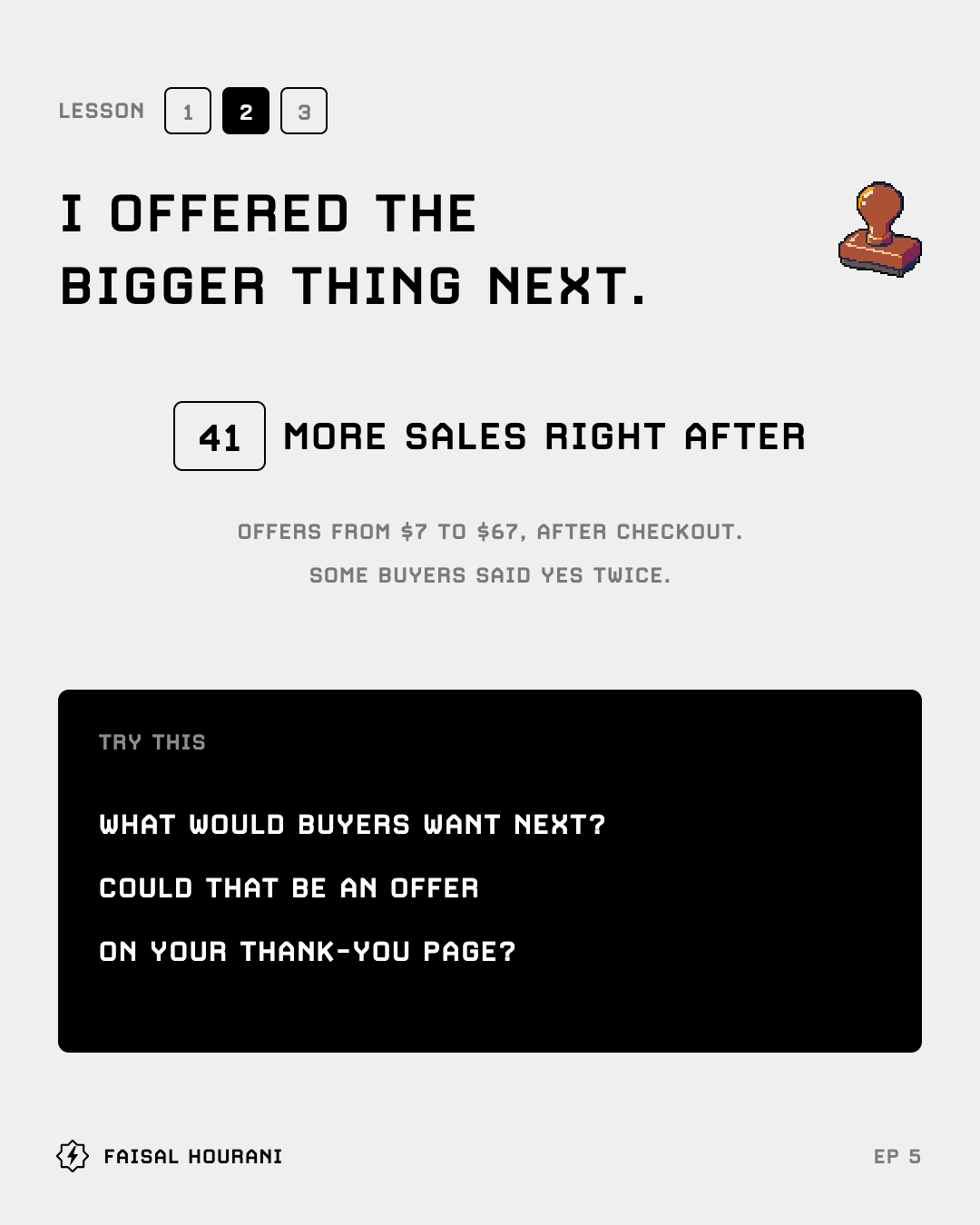
WHAT I DID1 in 5 of my buyers bought more right after checkout, on the thank-you page: 41 more sales, from $7 to $67.
COPY THISMy small first product is [product]. What is the one bigger product a buyer would want next? Write a thank-you page offer: a heading under 8 words, one line and the button text.
Lesson 2 from episode 5: I offered the bigger thing next, 41 more sales right after
STEP 7

Emails that keep going for a month

Some people sign up, then wait. If your emails stop after the first week, you miss them. A short series that keeps offering the small product for a few weeks catches the ones who need time. Want this built and tested for your store? See the AI marketing team I run for online brands.

Try this, if it fits: do your emails keep going after the first week?

WHAT I DID16 of my buyers joined my email list first, and bought 26 days later on average. One waited three months.
26 days on average
One waited three months
Emails for a month, not a week
Small first products

Six ideas to borrow.

Each one is a small yes from something the store already sells, with the bigger thing as the next offer.

Template shop

“Where does my money go?”

A $5 budget tracker

Next offer: the full finance tracker.

Printables shop

“I need a plan for this week.”

One week of planner pages

Next offer: the full-year planner.

Course creator

“Is this course for me?”

A short guide to lesson 1

Next offer: the full course.

Olive oil brand

“Will I like the taste?”

One small bottle or can

Next offer: the cooking and finishing pair.

Skincare brand

“Will it suit my skin?”

A travel-size cleanser

Next offer: the full routine.

Coffee roaster

“Which beans do I like?”

A three-bag sampler

Next offer: a monthly bag.

Want these steps planned for your store in 3 minutes? The free first product planner at the end of this page picks a small first product from what you sell, two prices to try, the one offer for your thank-you page and where to show it.

Questions

What people ask.

How do I sell digital products?

What worked for me: a small first product under $25, a box for it on the pages people already read, and the bigger thing offered on the thank-you page. More than 100 strangers bought my digital products that way, and 1 in 5 bought more right after.

What digital products sell best?

Small, specific ones that solve one problem. Every first product my buyers picked was a small pack between $5 and $22. The bigger products sold after, to people who had already bought.

How much should I charge for a digital product?

For a first product, under $25 worked for me. My first products sold at five prices from $5 to $22, and every price found buyers. Try two prices and count how many visitors buy at each.

Where should I sell digital products?

Your own site works if people find your pages. 15 of my buyers started on an article on my site, then bought the product it talks about. Marketplaces bring their own shoppers, but they take a fee on each sale.

What is a post-purchase upsell?

One offer shown right after someone buys, often on the thank-you page. Most stores get about 5 to 7 extra orders per 100 from it. On mine, 1 in 5 buyers said yes.

How do I deliver a digital product?

Most shop platforms send the file or the link by email right after payment; Shopify has a free Digital Downloads app, and tools like Gumroad do it for you. Test it once with your own email before you go live.

Free · 3 minutes

Your first product, planned.

Paste one prompt into your AI. Get a small first product from what you already sell, two prices to test and the one offer for your thank-you page.

What you get
  • One prompt for ChatGPT, Claude or Gemini. Just add your website.
  • A small first product under $25, from what you already sell.
  • Two prices to test, and how to pick the winner.
  • The one offer for your thank-you page.
  • Which of your pages should show it.
  • One follow-up email for people who haven't bought yet.

It opens right away, and the link comes by email too. Then a few short emails on building with AI. Leave any time.

Send it to one person

Who would this help?

If a friend runs a store or a site, it takes one tap to send it straight to them.

Email itWhatsApp it
Keep learning

More guides.

Each guide teaches one thing I learned while building.

Guide 1 · 10 steps · from EP1

How to build your brand, your first video and your website with AI.

Read the guide10 steps · 10 min →
Guide 2 · 5 steps · from EP2

How to reach Google's page one faster.

Read the guide5 steps · 5 min →
Guide 3 · 5 steps

How to rank in ChatGPT and get cited.

Read the guide5 steps · 5 min →
Guide 4 · 4 steps · from EP3

Lead magnet ideas that work.

Read the guide4 steps · 5 min →
Guide 5 · 7 steps · from EP4

A quiz funnel that gets the email.

Read the guide7 steps · 6 min →
Plan your first productOne prompt, free→